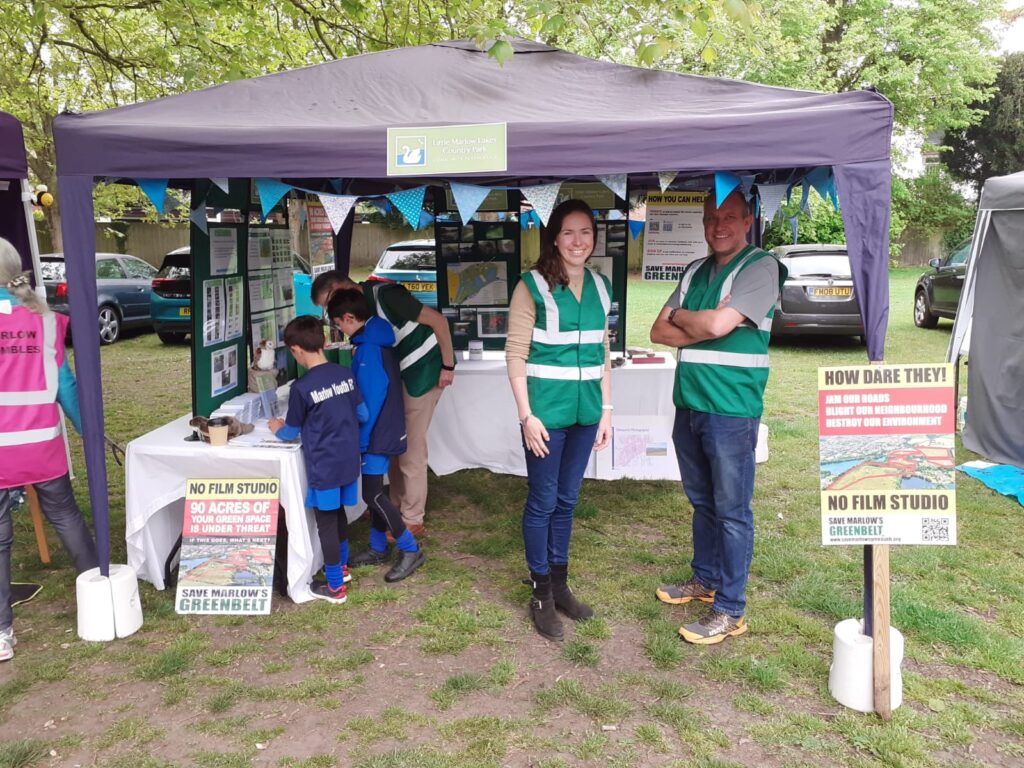
Volunteers from Save Marlow’s Greenbelt talked to the visitors at the Marlow May Fayre to explain all the threats to our local greenbelt. We were pleased to hear so much support for our cause – almost everyone opposed the developments. Thank you to everyone who stopped by to chat. We look forward to continuing to spread the word.
“Dear Marlow Film Studio neighbour in Little Marlow and Marlow,
We are very excited that there will be a filming of an action blockbuster at the Studio! We will be using the backlot (the one you usually walk your dogs in), which means we, unfortunately, have to close it for public access from tomorrow morning at 6 am until further notice. Please be aware that security patrols with dogs may be in operation 24/7.
Filming will also happen at night, with floodlights, so if you hear any shouting through megaphones, gunfire, explosions or sirens between 10 pm and 6 am over the next few weeks, please do not be alarmed. There is no cause for concern – it is all part of the excitement!
We are sorry for any inconvenience caused.
Warm regards from Oxfordshire, the Dido Property Limited (Guernsey) Team”
If you do not want to receive this email, it is not too late. Support Save Marlow’s Greenbelt now.
All proposed facilities in our greenbelt, and especially the Marlow Film Studio project, will put further strain on the nearby Thames Water Little Marlow Sewage Treatment Works (LMSTW).
Data from Event Duration Monitors at LMSTW (installed in 2018) shows a worrying trend of an increasing number of incidents and duration of sewage discharges:
Earlier in 2021, there was an equipment outage and Thames Water used their storm overflow tanks to minimise the sewage discharges, as described in their report to the March 2021 LMSTW Liaison Committee.
Clearly, there is limited to no additional capacity at the site. Working from home is having an effect (from the same report): “Thames Water confirmed the normal diurnal patterns of peak flow in morning and evening had been replaced with 12 hours of higher flow rates.”
In other words: “higher flow” is now the norm, without additional industrial complexes. Will this photo from the Environment Agency in 2013 of the Bourne End Marina become a normal sight on our Thames?
Planning decisions are made for our county by Buckinghamshire Council. We have been hearing lately about Little Marlow Parish Council or Marlow Town Council being consultees for development projects but they will not be the bodies determining if planning permission is granted.
Local councils are generally entitled to have an opinion on projects and have a duty to represent the views and best interests of their area. Some Buckinghamshire councillors who sit on planning committees may have to be careful not to give an opinion in advance of receiving all the facts (in case they are considered to be “pre-determined”) but for councillors who aren’t members of a Buckinghamshire planning committee, this is not a relevant consideration.
Some councillors in the area have expressed an opinion, however, none of the Marlow Town or Buckinghamshire councillors have publicly shared their thoughts.
This is concerning as Marlow Town Council have apparently have had off-the-record meetings with developers at the Crowne Plaza hotel and received a tour of the site as part of the Community Board. There is propaganda about the proposed film studio being circulated to thousand of local residents by the PR agency working for Dido Property Limited (Guernsey) and some councillors have been involved in the Community Liaison Group run by the developers.
It is inconceivable that our elected representatives have no opinion about something that would so fundamentally change Marlow, especially after all the information they have received. Why won’t they share their views?
Write to your councillors, parish, town and unitary authority (Buckinghamshire) and ask them to publicly state their reasoned opinion. If Joy Morrissey MP can come out publicly to express her concern, why can’t they?
The Marlow Film Studio project, and other developments, claim they will provide jobs for local people but do we need more local jobs?
The Office of National Statistics provides data about the Wycombe District (the smallest granularity available in the dataset). In 2020, there were 98,000 jobs available. However, there were only 92,400 people wanting to work. That’s everyone who is “economically active”, which means people who work or people who are classed as unemployed (i.e. available for work). There is therefore a shortfall of over 5,000 jobs that have no workers available to do them.
In addition, Buckinghamshire only has an unemployment rate of 3% (data from February 2022). The national average is 4.3% and places like Birmingham are struggling with unemployment of over 9%.
This is not an area that needs job creation and building a studio here does not support the government’s Levelling Up agenda to spread opportunity more equally across the UK.
Some of the jobs that Dido Property Limited (Guernsey) have been claiming will be created here included chefs, accountants and teachers. Search Indeed.com for those jobs within 5 miles of Marlow and you will find hundreds available already.
Many local businesses are currently struggling to fill vacant positions. We do not need more jobs here. We do not need to sacrifice Marlow’s Greenbelt for it.
There are many fancy and green artists impressions of the Marlow Film Studio project floating around, but what does a real film studio actually look like?
First of all, these are busy, utilitarian workspaces: large warehouse structures, with storage areas; a continuous 24/7 flow of deliveries & tradespeople; and security fences because production companies don’t want you snooping around!
Let’s do a visual reality check. For example, this is a snapshot of Pinewood:
A similar look in Shinfield, with large structures and a security fence on the right:
So, what might our view be from the A4155?
Or the footbridge over the A404?
All evidence of large film studio complexes points to a far less glamourous picture than the expensive marketing tries to paint. Don’t fall for it and help others see the reality.
Much has been written, mainly by the film industry and commercial property developers, about the need for more film studio space in the UK. A 2018 report by PwC put the figure at 0.9 million square feet more; a 2021 report by Lambeth Smith Hampton claimed 2.3 m sq ft was needed to meet demand by 2033.
So, how much is needed then? Thankfully, The Studio Map has area information on all 70+ studios and a helpful page listing all planned new stages in the UK.
We scraped the data and the following picture emerges:
The pipeline of planned projects already exceeds the anticipated demand by 2033. Many of these projects are expansions of existing studios or conversions of brownfield (industrial) sites.
What happens if there is overcapacity in the sector and studios stand empty? Well, there is an example: around 2010-2012, a planning application was approved to convert the then empty Bray Film Studios into housing. (In the end, Bray just received approval to expand their film studios.)
Why should we risk excess capacity on our Greenbelt? There are plenty of industrial sites across the UK more suited to this type of proposal.
You might have heard the terms “Greenbelt” and “Local Plan” being used in relation to the development threats. We want to make sure you know what they mean and why they exist.
Greenbelt
When people hear “Greenbelt”, they think of lush green fields, full of biodiversity. That may be the case, but the National Planning Policy Framework sets out the 5 specific purposes in a very pragmatic way. They are:
(a) to check the unrestricted sprawl of large built-up areas; (b) to prevent neighbouring towns merging into one another; (c) to assist in safeguarding the countryside from encroachment; (d) to preserve the setting and special character of historic towns; and (e) to assist in urban regeneration, by encouraging the recycling of derelict and other urban land.
None of these require high quality or biodiverse land. Marlow’s Greenbelt ensures that Marlow retains its character as a historic town with easy access to the countryside.
Local Plan
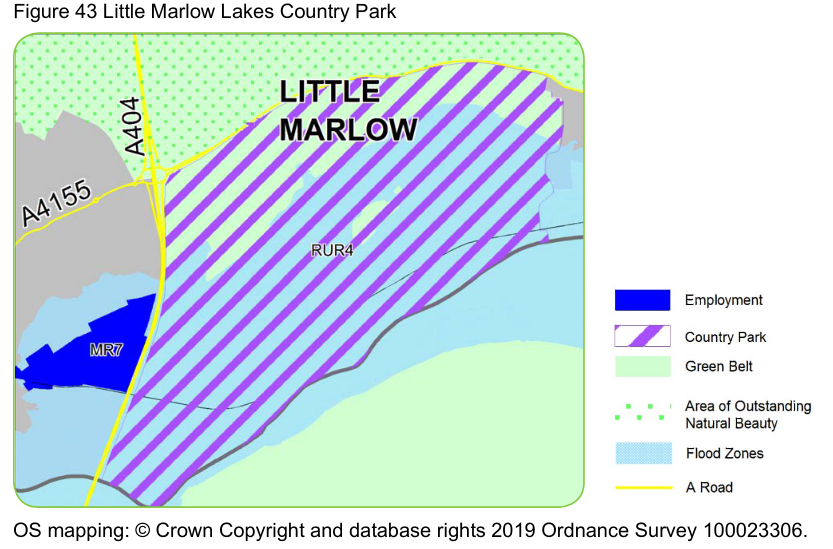
The Local Plan identifies specific sites for development & protection. As recently as 2019, (then) Wycombe District Council adopted the current Local Plan, covering the period 2019-2033. It explicitly states in section 5.5.20 (on page 222): “The whole of the area of the Little Marlow Lakes Country Park lies within the Green Belt”. It also shows the majority of the area is in the Thames flood plain and right next to the Chilterns AONB.
Policy RUR4 (on page 223) makes clear that the Country Park is allocated for outdoor recreation, publicly accessible open space and that “planning permission will not be granted for development within the Country Park that that has an adverse effect upon the amenities”.
Now you too know the multiple reasons why there should be no development of the sort proposed allowed in Marlow’s Greenbelt. Remind the councillors, the developers and tell your friends, family and neighbours.
Thank you to those who attended the meeting on Friday 1st April to hear the facts about Marlow’s Greenbelt and all the current threats to it. We were pleased to welcome about a hundred locals to our public meeting at Liston Hall.
The session provided information about several planned development projects in the wider Marlow area and then offered opportunities for members of the public to ask questions. Some local councillors attended but no one representing the developers was able to make it.
One attendee commented afterwards: “I came to [the] meeting quite ambivalent about the Film Project. …My view was quite turned around by your presentation. …This is an outrageous plan… [and] has to be stopped.”
We have received great feedback about how informative and insightful it was. If you have any further questions, please email us.